When we asked 818 creative professionals what “scaling” means to them, fewer than a third said growing into a larger team or agency. The rest described raising prices and working with fewer clients, building products that reach beyond the one-to-one relationship, developing a brand that earns attention without requiring their constant presence. Seven percent said they have no interest in scaling at all—that they are exactly where they want to be.
The majority of working creative professionals have already redefined growth. But most of them didn’t announce it. They built differently, priced differently, and selected clients differently until the cumulative effect became visible as a category.
That category is the Boutique Economy. This chapter explains why it emerged when it did.
The freelancer-to-studio (or agency) ladder rested on a single premise: more capacity meant more value. More clients generated more revenue. More staff generated more capacity.
The model compounded cleanly, as long as what was being sold was execution—hours, output, delivery.
Taste breaks that model. A design sensibility developed over fifteen years doesn’t multiply by hiring a junior. A client relationship built on the founder’s specific judgment doesn’t transfer automatically to the second person on the team.
The asset at the center of a boutique business—aesthetic authority, earned and particular—resists the scaling logic that worked for everything else.
Professionals who built on that asset started hitting a ceiling. Revenue plateaued. Capacity expanded but quality felt precarious. The model that generated the reputation was under pressure from the model required to monetize it.
That tension—between the integrity of the work and the demands of growth—is the fault line the Boutique Shift runs along.

The tension between taste and growth has always existed. What changed is that three conditions converged in the last decade to make each of the adjacent models visibly inadequate, and the boutique resolution visibly viable.
The first condition: technology and content platforms made aesthetic authority transmissible at scale. A creative professional’s point of view could now reach a prospective client before any conversation began—through a searchable body of work, a social presence, a reputation that traveled independently. Taste, once a private credential verified by referral, became a public one. That shift created the conditions for a new kind of creative business: one organized around a specific aesthetic vision rather than a general service offering.
The second condition: operational tooling caught up. Platform infrastructure that previously required a team—client management, proposals, scheduling, production, billing—became accessible to a two-person studio. The boutique model became economically viable not because professionals became more efficient, but because the tools met the ambition.
The third condition was a market failure that created the opening. When technology and tools became accessible to everyone, a particular kind of output flooded the market: polished, capable, and indistinguishable. Creator-led sectors produced cultural spikes without operational resilience. AI-driven platforms generated high volumes of competent work with no discernible identity behind it. The market got faster and more generic at the same time. Clients who could afford to choose started choosing the alternative: work with a specific human aesthetic at its center, where the judgment was particular and the provenance was clear.
The shift in what clients are actually buying is measurable. When we surveyed 945 clients, efficiency ranked first as the most valuable thing their professional provided (43%)—but vision, the ability to create something the client couldn’t have achieved alone, ranked second (39%). Personalization ranked third (34%). The transaction has moved away from time and toward judgment.
Professionals have been slower to follow: 27% still describe what clients pay for as their time and hands-on involvement. The gap between what clients say they’re buying and what professionals think they’re selling is one of the defining tensions this report maps.
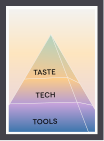
These conditions converged around a model that already had practitioners—founder-anchored, taste-driven, system-enabled. What the convergence did was make the model legible as a category, defensible as a strategy, and worth naming.
A boutique company is organized around a specific aesthetic logic that clients seek out and trust. That logic is made operational through tools, processes, and selective client relationships designed to protect its integrity. The business compounds by deepening the authority at its center and building the systems that let that authority travel—without the dilution that growth by headcount produces.
That structure has three layers, each playing a distinct role: taste as the driver, technology as the fuel, the tool stack as the engine. Chapter 2 maps the full architecture and what happens when any one layer is missing.

The chapters that follow map this economy from the inside: the asset at its center, the clients it serves, the labor it consistently undervalues, and the technological pressure it is navigating in real time. Each is built from the same field data—focus groups, interviews, and surveys of 818 professionals and 945 clients across personal styling, interior design, and wedding planning.