
In most industries, small means vulnerable. Small means squeezed on price, outspent on marketing, and eventually absorbed or replaced by something with more resources. That is the standard economic logic of scale, and for most of the last century it has been broadly correct.
But something is disrupting that logic. As AI lowers the cost of competent, generic output toward zero, the economic premium shifts toward what AI cannot replicate: accumulated aesthetic judgment, applied to a specific person’s specific problem, by someone with a track record of getting it right.
The businesses best positioned to capture that premium are not large firms with standardized processes—they are small, taste-led operators whose entire model is built around the thing that just became scarcer. That category has a name. This chapter defines it, locates it in the broader economy, and explains the structural conditions that are making it grow.
The Boutique Economy didn’t emerge from nowhere. It emerged from predecessor models—like the passion economy, the creator economy, the gig economy—each of which promised creative professionals independence and delivered something more complicated.
The passion economy told them they could monetize what they loved. Many did. But love, scaled through platforms and subscriptions, has a way of becoming obligation. The creator economy offered reach—algorithmic distribution, brand deals, audiences in the millions. It delivered that too, for the fraction who broke through. The gig economy offered flexibility: work when you want, for whom you want, on your terms. What it actually delivered, for most, was the overhead of a business without the upside of one.
All three models were built on volume. More clients, more content, more bookings. A platform takes its cut. An algorithm needs feeding. A gig rate, set by the market, doesn’t compound. The only way to earn more is to do more.
That model has a ceiling. For taste-led professionals, it has a specific problem: the thing that makes the work valuable doesn’t survive industrialization. A stylist [Christen Johnson] who built her practice around aesthetic judgment for women navigating identity transitions cannot template that. The judgment is the product. Volume dilutes it.
The Boutique Economy is what happens when taste-led professionals stop competing on volume and start competing on depth. It borrows the independence of the gig model and the audience-building logic of the creator model. But it organizes around a different unit of value: the accumulated aesthetic authority of a specific professional, applied to a specific client’s problem, in a way that cannot be replicated at scale.
That requires different pricing logic, different tools, and a different definition of what it means to grow.
An economy where professionals turn taste into capital—using judgment, systems, and technology to scale their distinct point of view. It’s defined by authorship, autonomy, and the ability to translate aesthetic intelligence into economic advantage.
It’s not a subset of the creator or passion economies.
It’s what happens after them—when taste is not just content and starts becoming an asset class.
The Boutique Economy didn’t happen because a handful of designers decided to go small. Several structural forces arrived at the same time, and their convergence made boutique not a lifestyle preference but a rational economic response.
The commodification of generic output. AI can now produce mood boards, color palettes, style guides, and project timelines at near-zero cost. What it cannot produce is the judgment behind them—the reason a specific combination of materials and proportions works for a specific client in a specific space at a specific moment in their life. As competent generic output becomes abundant, the premium migrates toward what is irreducibly human. Boutique professionals are not competing with AI. They are the thing that becomes more valuable as AI proliferates.
The legibility of taste. Social media didn’t just give boutique professionals a marketing channel. It made taste visible before the client relationship begins. A decade ago, a designer’s aesthetic was accessible only through an existing client or a physical portfolio. Now it is searchable and curated in real time. Clients identify a specific professional’s sensibility before making contact. They arrive already aligned. The professional arrives already trusted. That pre-qualified connection is the foundation the Boutique Economy runs on, and it has no equivalent in a volume model.
The revaluation of expertise. Something shifted in how clients think about professional services after years of platform-mediated, undifferentiated delivery. The evidence is in the data: when 945 clients were asked what made their boutique professional worth hiring, the top answer—given by 39%—was “their ability to create a vision I wouldn’t have achieved on my own.” Not price. Not efficiency. Vision. That is a market signal worth taking seriously.
The exit from corporate. A significant share of the most capable boutique professionals did not start their businesses to fill a market gap. They left something—a hierarchical architecture firm, a toxic management structure, an industry that rewarded output over judgment. In our focus groups, an interior designer, an architect, and a stylist: all described escaping environments where their aesthetic instincts were subordinated to someone else’s brief. The supply of boutique talent is driven, in part, by a generation of skilled professionals who would rather build something small and defensible than survive something large and corrosive. That is a labor market condition. It compounds.
Together, these forces describe a structural opening.
Ask a boutique professional what they sell and most will say some version of the same thing: their eye. Their taste. The ability to walk into a room—or look at a client—and know, with a speed that feels intuitive but isn’t, what works.
That answer is more economically significant than it sounds.
Across six focus groups, when participants free-associated the word “boutique,” the same cluster emerged every time: bespoke, curated, specialized, intimate, one-of-one.
Not a single participant reached for "scale", "efficiency", or "growth". And when clients in the survey were asked what made their professional worth hiring, “their ability to create a vision I wouldn’t have achieved on my own” ranked first—cited by 39% of 945 respondents.
Clients are not buying time. They are not buying project management. They are buying the thing at the top of the pyramid.
Taste sits at the top. It is the driver—the reason a client chooses one professional over another, the thing that justifies the price, and the asset that compounds with experience. It cannot be templated, franchised, or generated. It is what every other layer exists to express and protect.
Tech sits in the middle. This is where AI plugs in—not as a replacement for taste, but as a multiplier of it. Scheduling, client communications, mood board generation, trend research: the administrative and generative work that consumes time without producing judgment. Tech handles the volume so that taste can do the work only taste can do.
Tools form the base—the operational infrastructure that makes delivery consistent. Project management systems, supplier relationships, presentation formats. The engine that allows the pyramid to function without the professional rebuilding it from scratch for every client.
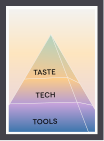
The Pyramid is diagnostic as much as it is descriptive. Remove any one layer and the economy's architecture fails—predictably.
No analyst has measured the Boutique Economy before, because until now it has had no name.
Interior designers, personal stylists, and wedding planners (and the other monikers they go by) sit in separate industry classifications, counted in separate databases, with no shared taxonomy. Sizing the category required triangulating three independent approaches: a supply-side count of practitioners across the cohorts, a demand-side reconstruction using our own survey data on client spend and engagement frequency, and a carve-out of the boutique-attributable share from published industry benchmarks. All three converge on the same range. Full methodology is provided in an appendix on request.
By our calculations, the US Boutique Economy generates $15 to $20 billion in annual economic value. Extend that figure across comparable markets in the UK, Canada, Australia, and Western Europe and the global total reaches $40 to $55 billion.
That number is large, but also underlabeled, undercounted, and significantly underpriced. The category has no dominant platform, no shared vocabulary, and no central point of aggregation. Its professionals are scattered across industry verticals that have never been analyzed together, which means the economic weight they collectively carry has been invisible—even to the people inside it.
The underpricing problem is structural rather than incidental. 83% of clients rate their boutique professional as good or excellent value — which means there is no perceived ceiling on price justification at current levels. Yet the survey's sharpest cross-reference finding is that professionals dramatically underestimate what clients are actually paying for. When 39% of clients identify the most valuable thing as “the ability to create a vision I wouldn’t have achieved on my own”—and professionals continue pricing by the hour—a portion of the category’s true value is being surrendered every day. The asset is taste. The invoice says time.
There is also a layer of the Boutique Economy that barely exists yet. When clients were asked about scalable digital offerings—curated guides, seasonal subscriptions, membership access to expertise—83% expressed at least some interest. More telling: 44% had already paid for a curated guide or kit outside a full-service engagement and found it valuable. That is not a hypothetical future market but one that exists now, largely uncaptured. The Sets layer—authored, repeatable expressions of taste priced for access rather than time—is the Boutique Economy’s next revenue frontier, and Chapter 5 maps how to build it.
The timing matters. As AI lowers the cost of generic creative output toward zero, the economic premium migrates toward what cannot be replicated: accumulated aesthetic judgment, applied specifically, by someone with a track record of getting it right. A $15 to $20 billion category built entirely on that premise is not a niche. It is the part of the creative economy that becomes more valuable the more AI proliferates.
While the instinct might be to conclude that the Boutique Economy is not running from what’s coming, on closer inspection—it is, structurally, the answer to it.

The gig economy gave creative professionals freedom. The creator economy gave them reach. Neither gave them the economic architecture to treat taste as the asset it actually is—something that accumulates with experience, converts across revenue streams, and defends against anyone who tries to replicate it at scale.That architecture exists. This report maps it.
The category it describes generates $15 to $20 billion in the US alone. It has no dominant platform, no shared vocabulary, no central point of capture. The professionals inside it are, in many cases, underpricing the most valuable thing they do.